

You are about to leave a GSK website
By clicking this link, you will be taken to a website that is independent from GSK. The site you are linking to is not controlled or endorsed by GSK and GSK is not responsible for its content.
Comprehensive biomarker testing may offer more clinical insights1,2
Real-world monitoring practices may diverge from the guideline recommendations for chronic hepatitis B (CHB).
MONITORING OF PATIENTS NOT ON TREATMENT
~50%
did not receive ALT and either HBV DNA or HBeAg testing within 12 months following CHB diagnosis3
MONITORING OF PATIENTS ON TREATMENT
>60%
did not receive ALT + HBV DNA testing after antiviral treatment initiation4
ADHERENCE TO MONITORING AND FOLLOW-UP CARE
40%–53%
of Asian-American patients with CHB adhere to monitoring and follow-up care, which is notably low, because despite making up 6% of the US population, Asian Americans account for 58% of Americans living with CHB5
Insufficient biomarker testing and subsequent delay in treatment initiation can increase the risk of disease progression and serious liver-related outcomes.6-10
CHB may lead to cirrhosis, liver failure, or HCC in 15%–40% of patients.6,11
Persistent viremia due to inadequate monitoring and lack of treatment adjustment contributes to ongoing liver injury and fibrosis progression.8-10
In 2022, HBV-related cirrhosis or HCC caused an estimated 1.1 million deaths globally.7
Emerging biomarkers may reveal clinical insights that complement the AASLD guidelines9
AASLD recommendations are based on HBeAg, HBV DNA, and ALT levels.9
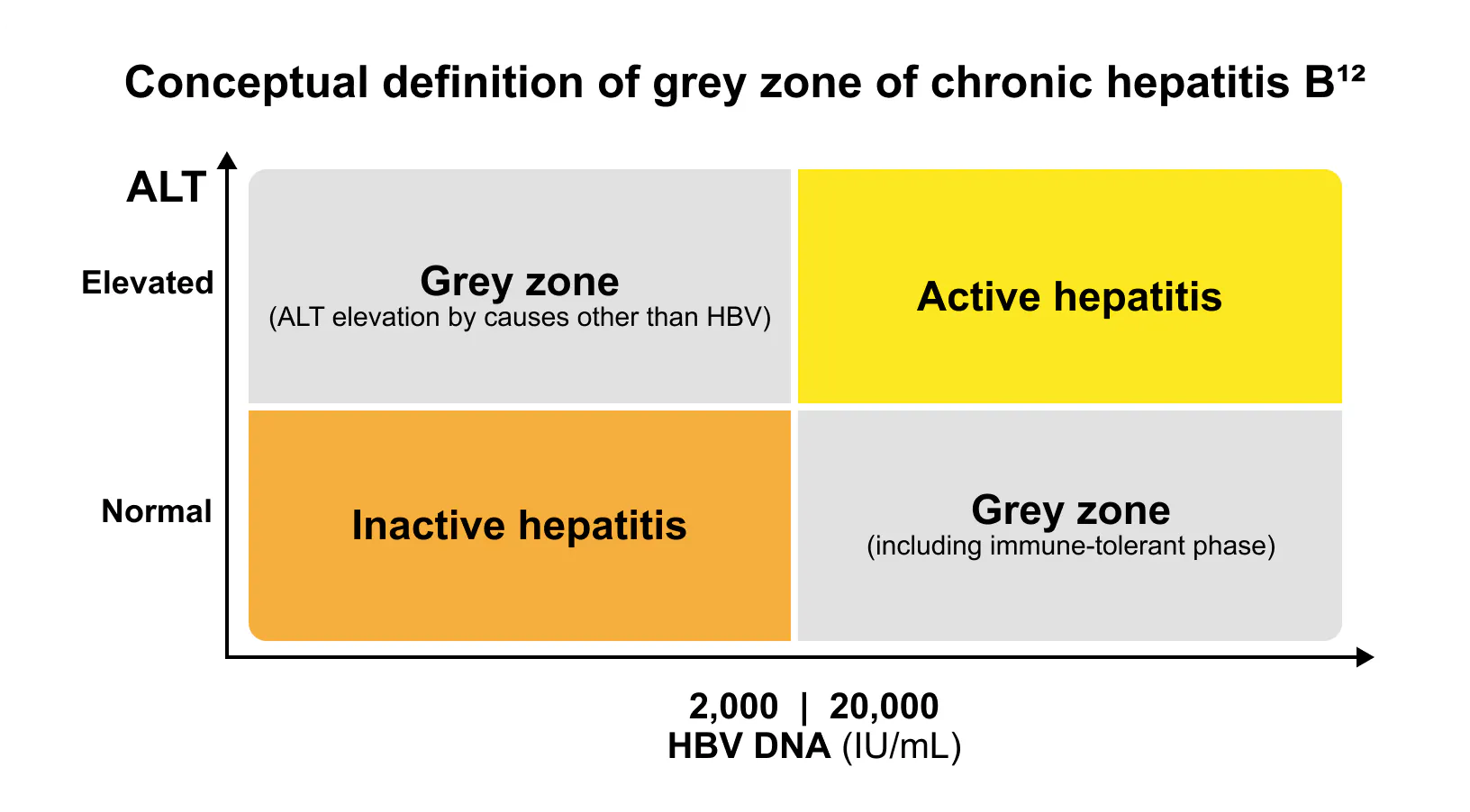
Figure used with permission. © 2024 Wolters Kluwer Medknow Publications. Lim YS. Grey zone of hepatitis B virus infection. Saudi J Gastroenterol. 2024;30(2):76-82. https://journals.lww.com/sjga/fulltext/2024/30020/gray_zone_of_hepatitis_b_virus_infection.2.aspx
28%–55% of patients with CHB are viremic, but fall into a "grey zone" without clear guidance on optimal management and treatment. The "grey zone" refers to patients who are HBeAg-positive or -negative with HBV DNA levels and/or ALT levels outside those with immune-tolerant, immune-active, or inactive CHB.13,14
- Quantitative HBsAg testing is an emerging biomarker gaining traction in international guidelines (EASL, CASL) due to its predictive and prognostic value, but it remains underutilized in US practice15-17
Quantitative HBsAg testing can help guide management of "grey zone" patients.9
- AASLD=American Association for the Study of Liver Diseases; ALT=alanine aminotransferase; CASL=Canadian Association for the Study of the Liver; DNA=deoxyribonucleic acid; EASL=European Association for the Study of the Liver; HBeAg=hepatitis B e-antigen; HBsAg=hepatitis B surface antigen; HBV=hepatitis B virus; HCC=hepatocellular carcinoma.
Explore comprehensive testing
References
Wong G, Lemoine M. J Hepatol. 2025;82(5):918-925.
Wong RJ. Gastroenterol Rep (Oxf). 2025;13:goaf016.
Pham T, et al. Med Care. 2023;61(4):247-253.
Zhou Y, et al. J Viral Hepat. 2022;29(3):189-195.
Ma GX, et al. Healthcare (Basel). 2022;10(10):1944.
Fattovich G. J Hepatol. 2003;39(suppl 1):S50-S58.
Hepatitis B. World Health Organization. July 23, 2025. Accessed March 11, 2026. https://www.who.int/news-room/fact-sheets/detail/hepatitis-b
Zhang Q, et al. J Clin Transl Hepatol. 2021;9(6):850-859.
Terrault NA, et al. Hepatology. 2018;67(4):1560-1599.
Sun Y, et al. Clin Gastroenterol Hepatol. 2020;18(11):2582-2591.
Lavanchy D, Kane M. Global epidemiology of hepatitis B virus infection. In: Liaw YF, Zoulim F, eds. Hepatitis B Virus in Human Diseases. Humana Press; 2016:187-203.
Lim YS. Saudi J Gastroenterol. 2024;30(2):76-82.
Ghany MG, et al. Hepatology. 2025. doi:10.1097/HEP.0000000000001549
You H, et al. Infect Dis Immun. 2023;3(4):145-162.
European Association for the Study of the Liver. J Hepatol. 2025;83(2):502-583.
Coffin CS, et al. Can Liver J. 2018;1(4):156-217.
Mahajan A, et al. J Viral Hepat. 2024;31(11):746-759.